Loading...
Searching...
No Matches
hermes.core.scheduler.Scheduler Class Reference
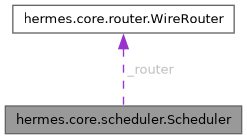
Collaboration diagram for hermes.core.scheduler.Scheduler:
Public Member Functions | |
| None | __init__ (self, ProcessManager process_mgr, ExecutionConfig config) |
| int | frame (self) |
| float | time (self) |
| int | time_ns (self) |
| float | dt (self) |
| int | dt_ns (self) |
| bool | running (self) |
| bool | paused (self) |
| ExecutionMode | mode (self) |
| None | stage (self) |
| None | step (self, int count=1) |
| None | reset (self) |
| None | run (self, Callable[[int, float], Awaitable[None]]|None callback=None) |
| None | pause (self) |
| None | resume (self) |
| None | stop (self) |
Public Attributes | |
| time | |
Static Public Attributes | |
| int | NANOSECONDS_PER_SECOND = 1_000_000_000 |
Protected Attributes | |
| _pm = process_mgr | |
| _config = config | |
| int | _frame = 0 |
| int | _time_ns = 0 |
| int | _dt_ns = config.get_dt_ns() |
| bool | _running = False |
| bool | _paused = False |
| bool | _needs_wall_rebase = False |
| WireRouter|None | _router = None |
| dict | _module_substeps = {} |
Detailed Description
Runtime simulation scheduler.

Controls simulation execution with support for realtime, AFAP,
and single-frame modes. Coordinates with ProcessManager for
module stepping and provides pause/resume/stop control.

Example:
    >>> scheduler = Scheduler(process_mgr, config.execution)
    >>> scheduler.stage()
    >>> await scheduler.run(callback=my_telemetry_fn)
Constructor & Destructor Documentation
◆ __init__()
| None hermes.core.scheduler.Scheduler.__init__ | ( | self, | |
| ProcessManager | process_mgr, | ||
| ExecutionConfig | config ) |
Initialize the scheduler.

Args:
    process_mgr: ProcessManager for controlling modules
    config: Execution configuration (mode, rate, end_time)
Member Function Documentation
◆ dt()
| float hermes.core.scheduler.Scheduler.dt | ( | self | ) |
Timestep in seconds.

Derived from `dt_ns` for API convenience.
◆ dt_ns()
| int hermes.core.scheduler.Scheduler.dt_ns | ( | self | ) |
Timestep in nanoseconds.

This is the authoritative timestep value for deterministic simulations.
◆ frame()
| int hermes.core.scheduler.Scheduler.frame | ( | self | ) |
Current simulation frame number.
◆ mode()
| ExecutionMode hermes.core.scheduler.Scheduler.mode | ( | self | ) |
Current execution mode.
◆ pause()
| None hermes.core.scheduler.Scheduler.pause | ( | self | ) |
Pause the run loop.

The simulation will stop advancing but remain in the run loop.
Use resume() to continue.
◆ paused()
| bool hermes.core.scheduler.Scheduler.paused | ( | self | ) |
Whether the simulation is paused.
◆ reset()
| None hermes.core.scheduler.Scheduler.reset | ( | self | ) |
Reset simulation to initial state.

Resets frame/time counters, flags wall_start for rebasing so
realtime pacing resumes correctly, and resets all modules to
their initial conditions (restoring signal values).
◆ resume()
| None hermes.core.scheduler.Scheduler.resume | ( | self | ) |
Resume the run loop after pause.
◆ run()
| None hermes.core.scheduler.Scheduler.run | ( | self, | |
| Callable[[int, float], Awaitable[None]] | None | callback = None ) |
Run simulation loop until stopped or end_time reached.

In realtime mode, paces execution to wall-clock time.
In AFAP mode, runs as fast as possible.
In single_frame mode, waits for explicit step() calls.

Args:
    callback: Optional async callback invoked after each frame
             with (frame_number, simulation_time_seconds)
◆ running()
| bool hermes.core.scheduler.Scheduler.running | ( | self | ) |
Whether the simulation run loop is active.
◆ stage()
| None hermes.core.scheduler.Scheduler.stage | ( | self | ) |
Stage simulation for execution.

Calls stage() on all modules via ProcessManager, configures
wire routing, and resets frame/time counters to zero.
◆ step()
| None hermes.core.scheduler.Scheduler.step | ( | self, | |
| int | count = 1 ) |
Execute N major frames.

Each major frame routes wires, then steps each module according to
its configured rate (faster modules sub-step multiple times).

Args:
    count: Number of major frames to execute (default: 1)

Raises:
    ValueError: If count is not positive
◆ stop()
| None hermes.core.scheduler.Scheduler.stop | ( | self | ) |
Stop the run loop.

The simulation will exit the run() method cleanly.
◆ time()
| float hermes.core.scheduler.Scheduler.time | ( | self | ) |
Current simulation time in seconds.

This is derived from `time_ns` for API convenience.
For deterministic comparisons, use `time_ns` instead.
◆ time_ns()
| int hermes.core.scheduler.Scheduler.time_ns | ( | self | ) |
Current simulation time in nanoseconds.

This is the authoritative time value for deterministic simulations.
Use this for exact comparisons and reproducibility.
Member Data Documentation
◆ _config
|
protected |
◆ _dt_ns
|
protected |
◆ _frame
|
protected |
◆ _module_substeps
|
protected |
◆ _needs_wall_rebase
|
protected |
◆ _paused
|
protected |
◆ _pm
|
protected |
◆ _router
|
protected |
◆ _running
|
protected |
◆ _time_ns
|
protected |
◆ NANOSECONDS_PER_SECOND
|
static |
◆ time
| hermes.core.scheduler.Scheduler.time |
The documentation for this class was generated from the following file:
- src/hermes/core/scheduler.py